OpenAI and Apple Partnership in Jeopardy: Legal Action Looming Over Alleged Contract Breach
Introduction
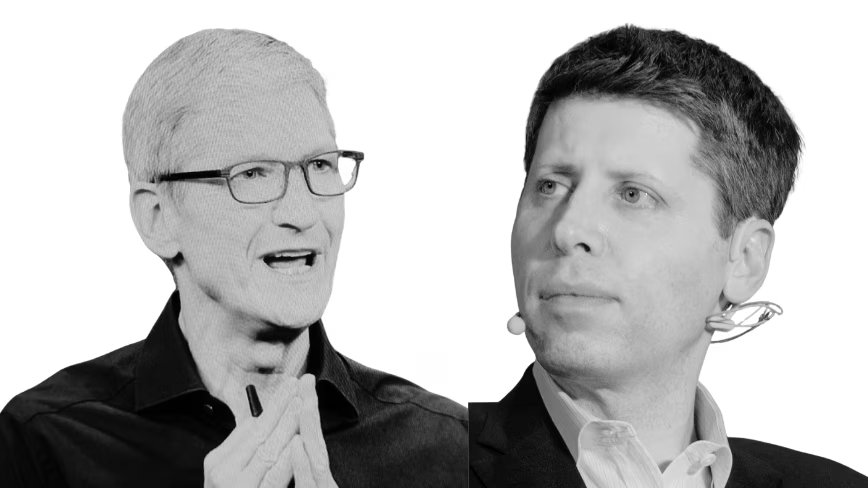
The high-profile partnership between OpenAI and Apple, announced with great enthusiasm in June 2024, appears to be unraveling. According to a report from Bloomberg citing unnamed sources familiar with the matter, the artificial intelligence company is preparing to escalate the dispute by potentially filing a formal breach of contract notice against the tech giant. While no lawsuit has been initiated yet, OpenAI’s legal team is actively working with an external law firm to evaluate possible remedies, including litigation.
Background of the Partnership
Announced Amid Fanfare
In June 2024, Apple and OpenAI unveiled what many described as a landmark collaboration. The partnership aimed to integrate OpenAI’s advanced AI models into Apple’s product ecosystem, promising features like enhanced Siri capabilities, on-device AI assistants, and improved natural language processing. The deal was often compared to the recent $20 billion search agreement between Google and Apple, as it carried significant strategic weight for both companies.
Strategic Importance
For OpenAI, the Apple partnership provided a massive distribution channel to reach hundreds of millions of iOS users. For Apple, it was a way to catch up in the AI race without building a large language model from scratch. The agreement was seen as a win-win, with potential revenue sharing and exclusivity clauses similar to those in the Google-Apple search deal.
Current Dispute: Alleged Breach of Contract
Details Emerging
According to the Bloomberg report, OpenAI’s lawyers are now drafting a notice to Apple, alleging that the Cupertino company has failed to meet its contractual obligations. The specific terms under dispute have not been disclosed, but experts speculate they could relate to data sharing, exclusivity, performance benchmarks, or financial terms.
Legal Preparations
OpenAI has retained a prominent outside legal firm to advise on the situation. Options on the table include sending Apple a formal notice of breach, which could be a precursor to legal action, or attempting to renegotiate the terms. A lawsuit, if filed, could lead to a protracted legal battle that might expose the inner workings of both companies’ AI strategies.
Potential Implications
Impact on the AI Industry
If the partnership collapses, it could reshape the competitive landscape. Apple might accelerate its own AI research or seek other partners, such as Google’s DeepMind or Anthropic. OpenAI, on the other hand, would lose a key distribution channel and might face increased pressure to secure other high-profile deals.

Market Reactions
Analysts have noted that the dispute could affect investor confidence in both companies. Apple’s stock, which has been buoyed by AI promises, might see volatility. OpenAI, as a private entity, could face challenges in future fundraising if its partnership network appears unstable. The situation also raises questions about the viability of exclusive AI partnerships in an era of rapid technological change.
What’s Next?
Possible Scenarios
- Negotiated settlement: Both sides could agree to modify the contract terms, avoiding litigation.
- Breach notice and lawsuit: OpenAI sends the formal notice, followed by a court case that could drag on for years.
- Mutual dissolution: The partnership is terminated amicably, with each company pursuing independent AI strategies.
Industry insiders suggest that the outcome will depend on how strongly each party values the relationship versus their willingness to fight over contractual specifics.
Conclusion
The once-celebrated OpenAI-Apple partnership is now in turbulent waters. With legal teams mobilized and a breach notice possible, the tech world is watching closely. This dispute highlights the challenges of forging AI alliances in a fast-moving industry where expectations and realities often diverge. For now, no lawsuit has been filed, but the clock is ticking on one of the most intriguing corporate dramas of 2024.
For more details, see the original report on The Next Web.